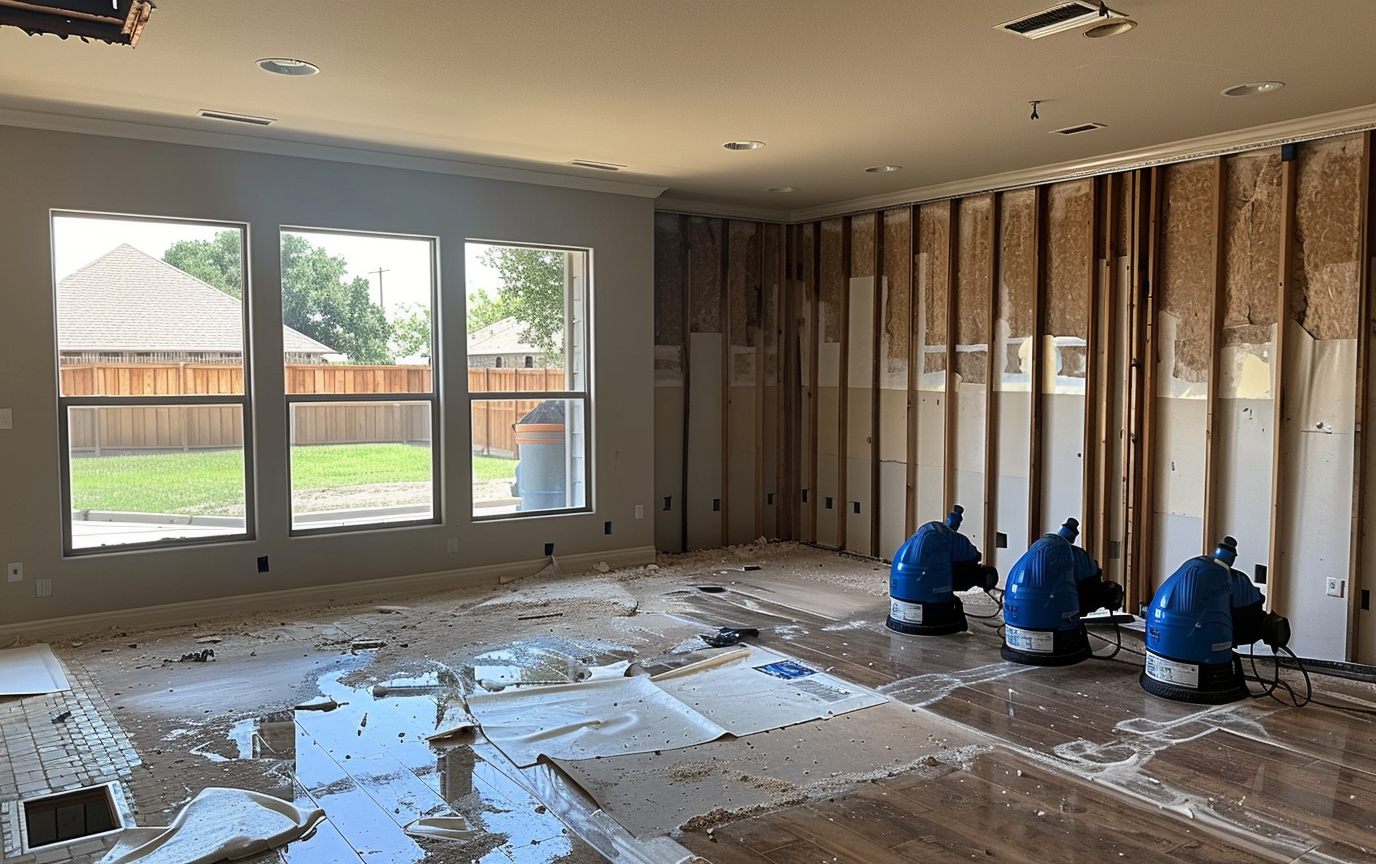
What a Water Mitigation Company Does First
A water mitigation company's first job is to keep the damage from getting bigger. That means stopping the source, making the area safe, pulling out standing water, finding everywhere the water went and starting the drying. Water damage restoration is the whole job, from that first visit through dried framing, new drywall, new baseboards and paint. Water damage remediation is another name you'll see for the mitigation phase. In Kyle, where most homes are slab-on-grade with laminate or carpet on concrete, the mitigation phase decides how much of the floor and the lower walls can be saved.
Mitigation, Restoration and Repair
| Term | What it covers | When |
|---|---|---|
| Water mitigation | Stopping the source, extraction, moisture mapping, removing what can't be dried, drying with readings | First, in the first days |
| Water damage restoration | The whole process: mitigation through rebuilt rooms | Start to finish |
| Water damage repair | Drywall, insulation, flooring, cabinets, trim and paint | After the structure reads dry |
Insurers often look at mitigation and repair separately, and some companies do only one of the two. Ask which your company does.
The Process, Step by Step
- Stop and make safe. Water off at the fixture or main; power to wet areas checked.
- Document. Photos of the damage as found, before anything is moved.
- Extract. Pumps and extractors for standing water; carpet pad pulled.
- Map the moisture. Meters and a thermal camera find water under flooring, inside walls and in the ceiling.
- Remove what can't be dried. Usually pad, swollen baseboards, soaked insulation and the bottom of wet drywall.
- Dry with readings. Air movers and dehumidifiers run, with readings each visit until the structure matches dry areas.
- Repair. Drywall, baseboards, flooring and paint go back.
What Usually Stays and What Goes
| Material | Usually | Why |
|---|---|---|
| Drywall | Dried in place after clean water caught early; cut at the bottom if soaked or dirty | Gypsum wicks water upward |
| Baseboards (MDF) | Replaced | MDF swells and doesn't recover |
| Laminate | Often replaced | Water sits under it and swells the core |
| Engineered or solid wood | Sometimes dried; replaced if it cups badly | Wood can flatten with slow drying |
| Carpet and pad | Pad replaced; carpet sometimes dried after clean water | Pad holds water like a sponge |
| Tile on slab | Usually stays; grout and the slab under it are dried | Tile doesn't absorb much |
| Cabinets | Solid wood often saved; particleboard often replaced | Particleboard swells |
Drying a House in a Texas Summer
Drying equipment adds heat and draws power, and in a Kyle summer that matters. Air movers and dehumidifiers run day and night for several days, the rooms get warm, and the AC works harder. Expect the company to close off the drying area where it can, ask you to keep certain doors shut, and tell you which circuits the equipment is on. Most families stay home during a clean-water drying job; with equipment in bedrooms, or after flood water, some don't.
The Records You Should End Up With
A good job leaves a paper trail: photos as found, a moisture map with daily readings, an inventory of every removed material with the reason, and the repair scope. Those records are what your insurer works from, what a buyer's inspector will ask about if you sell, and what you'll want if a stain ever reappears. Get copies of all of it before the drying equipment is picked up.
How Long Does Restoration Take in a Kyle Home?
Mitigation and drying for an ordinary leak often take several days. Repairs follow once readings confirm the structure is dry, and how long those take depends on how much was removed and on scheduling. Slab moisture, wall cavities and flood jobs take longer. After the first visit, the company can tell you what to expect. What it costs depends on the same things: what water damage repair costs depend on.
Where Water Hides in a Slab House
On a slab, water doesn't drain away; it spreads. It runs under interior walls into the next room, under kitchen cabinets and islands, beneath laminate and vinyl plank, and up the back of the drywall by wicking. That's why mitigation companies map moisture well past the visible wet spot. Common hiding places in Kyle homes:
- under the kitchen cabinets and the dishwasher
- along the wall shared with a bathroom or laundry
- under the carpet pad at the tack strip
- behind baseboards in the next room over
- in the attic insulation above any ceiling stain
Questions to Ask the Restoration Company
- How will you document the drying, and will I get copies of the readings?
- Do you handle repairs too, or only mitigation and drying?
- What will you remove, and why?
- How do you work with insurance companies?
- What happens if you find more damage than expected?
Good companies answer these without hesitation. If your home is newer, also see water damage in a newer home, since builder coverage can affect who pays.
Restoration Around Kyle
Kyle
- Plum CreekKyle
- Hometown KyleKyle
- Bunton CreekKyle
- Southlake RanchKyle
- Kensington TrailsKyle
- Four Seasons FarmKyle
- AmberwoodKyle
- Historic Downtown KyleKyle
North
South
West
East
Main page: water damage restoration in Kyle.